
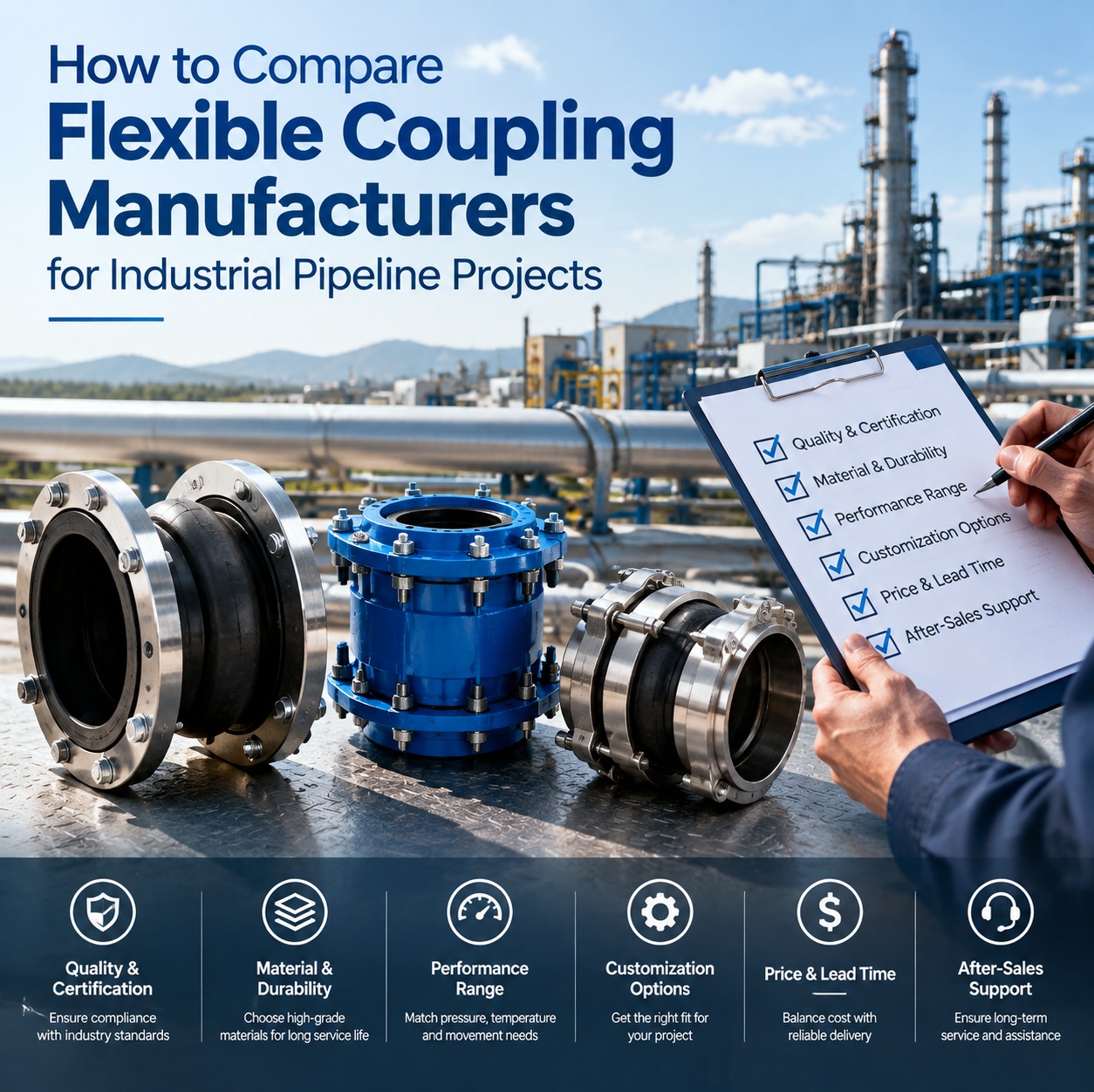
 Nobody remembers the coupling that held. They remember the one that let go at 3 a.m. during a commissioning run, soaking a pump room and pushing a startup date back two weeks. That asymmetry is the whole game. A flexible coupling is a small line item on a bill of materials, but it sits at the intersection of pressure, vibration, thermal movement, and human installation error. So when you are comparing manufacturers, you are not really shopping for hardware. You are shopping for the odds that nothing goes wrong.
Most buyers start with price per unit. That is backwards. Start with the paperwork, because the paperwork tells you what the hardware actually is.
Certificates First, Catalog Second
Any manufacturer can print a spec sheet. Far fewer can hand you a valid certificate with a file number you can look up yourself. For grooved and mechanical pipe couplings used in fire protection, you want UL 213 and FM 1925 listings, and you want to verify the file numbers on the listing body’s own database, not on the supplier’s PDF. For potable water, NSF/ANSI 61 and NSF/ANSI 372 matter, and they matter for the gasket, not just the housing. For European projects, PED 2014/68/EU compliance and a notified body number should appear without you having to ask twice.
If a sales rep says “we are UL listed” but cannot produce a file number in under five minutes, treat that as a no. It is not a negotiating tactic. It is a signal about how the rest of the relationship will go.
Where the Metal Actually Comes From
Here is a question that separates real factories from trading companies: who pours your housings?
Ductile iron to ASTM A536 grade 65-45-12 is the baseline for quality couplings. The mechanical properties matter because a coupling housing is a pressure-containing component that also gets abused by wrenches, dropped on concrete, and torqued by someone who skipped breakfast. Malleable iron shows up in cheaper lines, and sometimes it is acceptable for low-pressure service. Sometimes. The problem is that you rarely know which one you are getting unless the manufacturer has an in-house foundry or a locked, audited supply chain with heat-lot traceability.
Ask for a mill certificate tied to a specific production lot. Then ask whether the same heat numbers appear on the couplings they shipped you last quarter. Consistency across lots is the quiet indicator of process control, and it is the thing trading companies cannot fake.
Gasket Compound: The Cheapest Place to Hide a Problem
The elastomer is where margins get recovered. A gasket that looks identical to EPDM might be a reclaimed compound with unpredictable compression set. You find out eighteen months later when a joint weeps in a chilled water loop.
Compare manufacturers on this specifically. Ask for the compound designation, the cure system, the temperature range with a documented basis, and the fluid compatibility chart. EPDM covers a lot of water and steam service. Nitrile handles hydrocarbons. Fluoroelastomer shows up in aggressive chemical and high-temperature lines. Silicone has its niche in high-temperature dry service.
Then ask the uncomfortable follow-up: has this exact compound been tested in the exact coupling geometry you are quoting? A great gasket in a poorly designed gland is still a leak.
Test Data Beats Promises
Pressure ratings are where marketing language gets loose. A 300 psi rating means nothing without the test conditions. Was it hydrostatic, how long, at what temperature, with what gasket, and did the joint see any angular or lateral deflection during the test?
Look for manufacturers who publish burst test results, vacuum ratings, and deflection capability curves, and who reference recognized standards such as AWWA C606 for grooved joints or ASTM F1476 and F1548 for flexible couplings and expansion joints. Third-party test reports carry more weight than internal ones. A supplier who volunteers data before you ask is usually a supplier who has it.
Dimensional Consistency and Field Fit
This one is underrated and it costs contractors real money. If coupling dimensions drift between shipments, pipe fitters improvise. Improvised fits become leaks. Ask how the manufacturer controls casting dimensions and machining tolerances, and whether they will send you a dimensional report from a recent lot.
A practical test: order a small sample from two or three shortlisted suppliers, then measure them side by side. Housing wall thickness, bolt hole alignment, gasket seat profile. You will learn more in an afternoon with calipers than in three weeks of email.
Coating and the Corrosion Story
The environment decides this. Buried service, coastal plants, chemical plants, and food processing floors all punish coatings differently. Hot-dip galvanized is common and adequate in many outdoor applications. Fusion-bonded epoxy and phenolic coatings handle more aggressive conditions. Painted housings with no surface prep are a cost-cutting tell.
Ask what the coating thickness is, what standard it meets, and whether the bolts and nuts get the same treatment as the housing. Mixed metallurgy fasteners are a classic failure point.
The Paper Trail That Saves You Later
When an inspector, insurer, or client asks for documentation two years after installation, you want to be able to produce it without begging. Compare manufacturers on what ships with the order:
– Mill certificates for housings and fasteners – Gasket compound certificates with lot numbers – Hydrostatic and burst test reports – Coating thickness reports – Installation instructions in the project language – Warranty terms with clear duration and scope
A manufacturer who treats documentation as an optional add-on is telling you how they handle problems.
Lead Time, MOQ, and the Real Cost
Cheap units with a fourteen-week lead time are not cheap. Neither is a supplier who requires a container-load minimum when you need forty pieces for a retrofit. Map the total cost: unit price, freight, duties, expedite fees, storage, and the cost of a single failure.
Then weigh it against responsiveness. A supplier who answers technical questions in a day and ships samples in a week is worth a few percent more per unit. Every time.
Ask the Awkward Questions
Good manufacturers enjoy this part. Poor ones get defensive. Try these:
Who is your technical contact for expansion and deflection calculations? Can you provide installation training or a site visit? What is your defect rate over the last twelve months? Can we audit your factory, or send a third party? What happens if a lot fails incoming inspection?
The answers matter less than the willingness to answer. Evasiveness is the finding.
Reference Checks That Mean Something
Ask for three references on projects similar to yours in size, fluid, and pressure class. Not the biggest projects they have ever done. Comparable ones. Then call and ask one question: would you use them again, and what would you change? The second half of that question is where the truth lives.
Red Flags Worth Walking Away From
No verifiable certification file numbers. No heat-lot traceability. Pressure ratings with no test basis. Gasket compounds described only as “rubber.” A refusal to allow factory audits. Quotes that change significantly after technical clarification. Any of these, and the cheapest bid stops being the cheapest option.
Comparing flexible coupling manufacturers is really an exercise in reading intent. The good ones hand over data, invite scrutiny, and put their name on a certificate you can verify. The others talk about relationships and discounts.
Start with the certificates. End with the audit. Everything in between is just confirming what the paperwork already told you.